
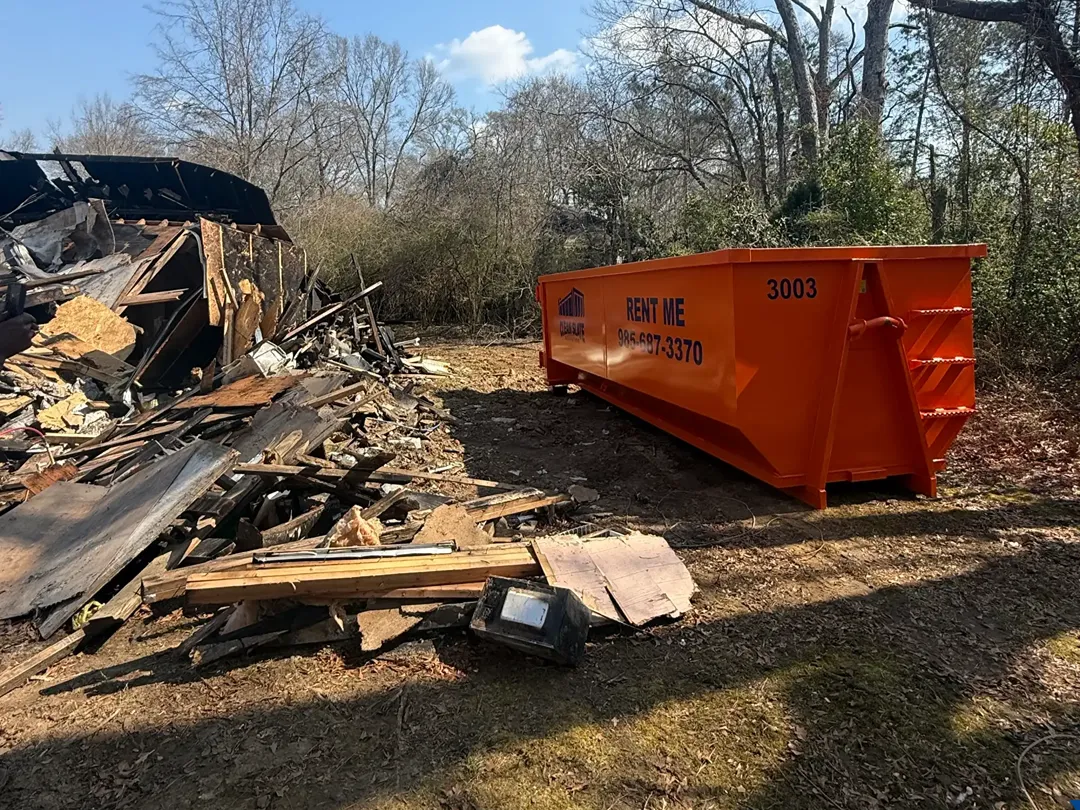
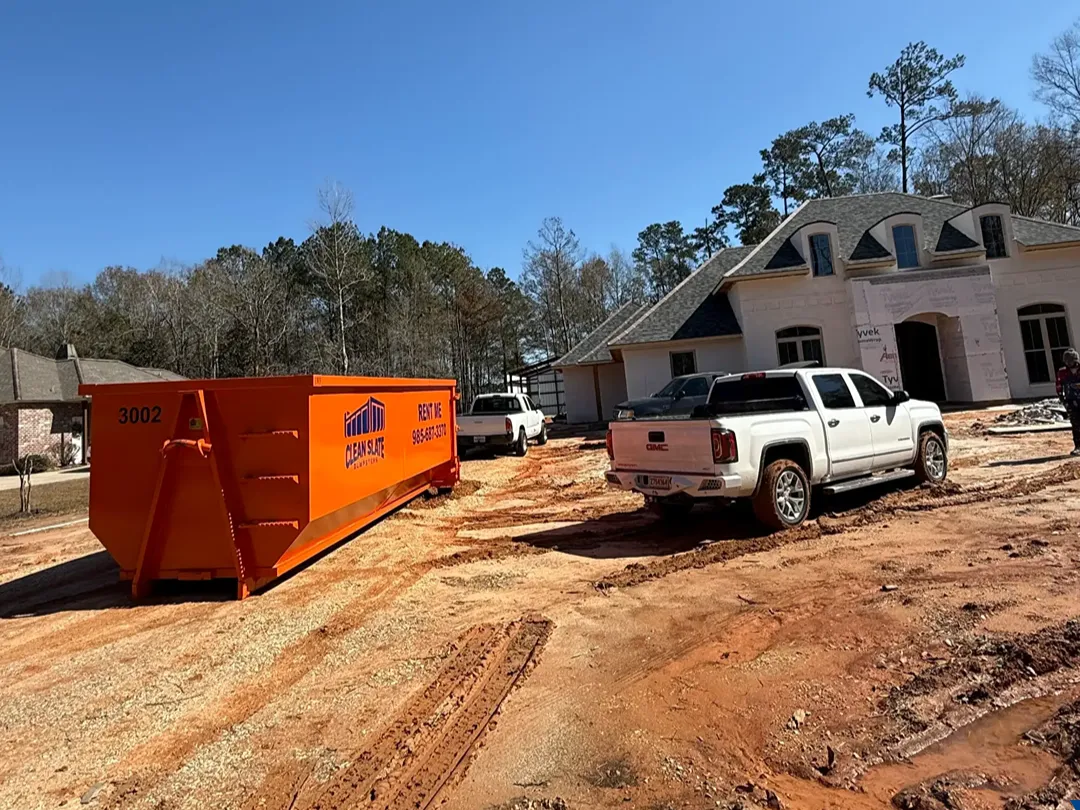
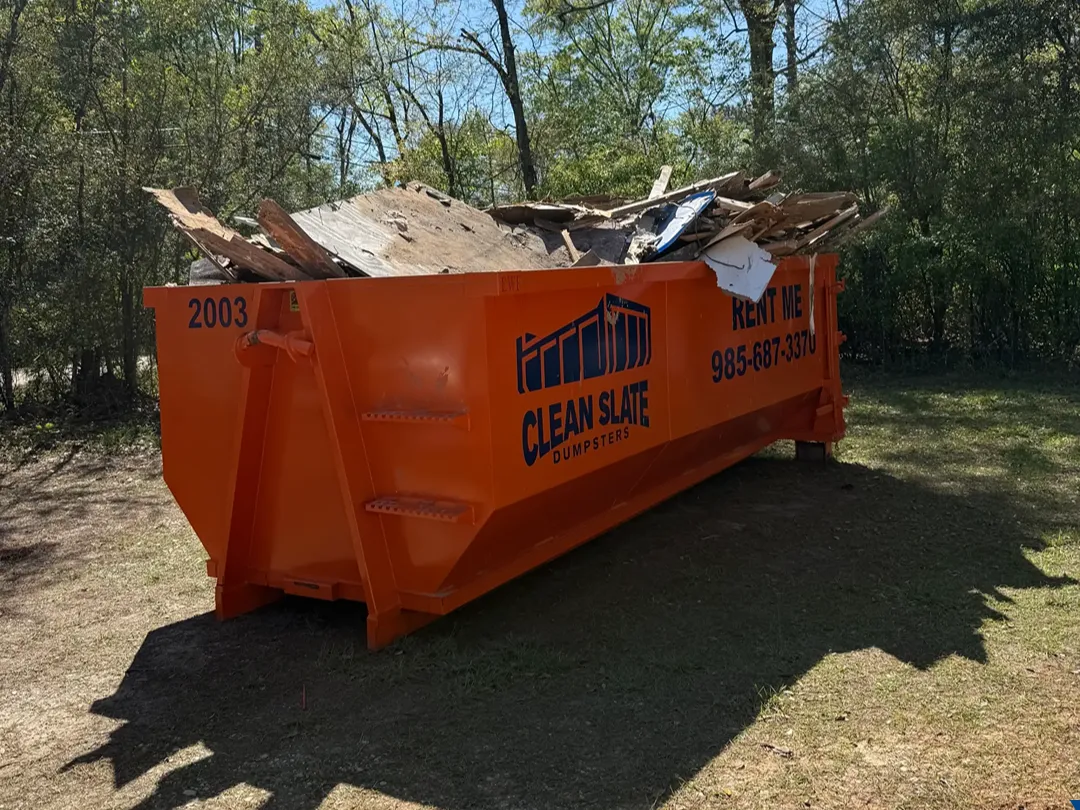
The most-asked question Clean Slate Dumpsters gets isn’t “what size dumpster do I need?” It’s “I’m between two sizes; which one do I pick?” The 15-vs-20 and 20-vs-30 decisions are where most Hammond homeowners get the math wrong.
Pick the smaller and pay twice when a second delivery shows up to finish the job. Pick the bigger and a chunk of the rental fee covers empty air. Both happen weekly across Hammond and Ponchatoula driveways. This guide is the math that settles the close calls.
The short answer: Sizing up only pays off on a cost-per-cubic-yard basis at the 30-yard, which costs $16.63/yd. The 20-yard and the 15-yard are close at $19.95/yd and $19.93/yd, so that call comes down to capacity and included tonnage rather than price per yard. The smaller size only wins if (1) the project genuinely fits, (2) driveway access doesn’t allow the larger, or (3) the included tonnage on the smaller bin is enough for heavy debris. For most Hammond homeowners deciding between 15-and-20, pick the 20. For most deciding between 20-and-30, the 20 still wins unless the project is whole-house or full-remodel scale.
Both the 15-vs-20 and the 20-vs-30 decisions usually break the same way: the larger bin wins on cost-per-cubic-yard and cost-per-ton, and the smaller bin wins on driveway fit and small-project simplicity. The table below is the lookup that handles most calls.
| Project Type | Recommended Size | Decider |
|---|---|---|
| Garage cleanout (one car, light load) | 15-yard | Volume fits; tonnage isn’t the constraint |
| Garage cleanout (two car or mixed) | 20-yard | Tonnage headroom for unexpected additions |
| Single-room remodel (bathroom only) | 15-yard | Small volume, predictable debris |
| Kitchen remodel | 20-yard | Drywall is heavy; 1-ton cap is the fail point |
| Whole-house cleanout | 30-yard | Capacity and tonnage both needed |
| Single-layer asphalt roof tear-off | 15-yard or roofing flat-rate | Weight-bound, not volume-bound |
| Shed or deck demolition | 20- or 30-yard | Mixed debris with heavier mass |
| Concrete removal (small slab) | 15-yard | Weight-bound; volume not the constraint |
| Active contractor jobsite (multi-day) | 30-yard | Capacity + tonnage + extended rental |

Full ton and extra-day math sits on the Clean Slate Dumpsters pricing breakdown for any project that doesn’t fit the table cleanly.
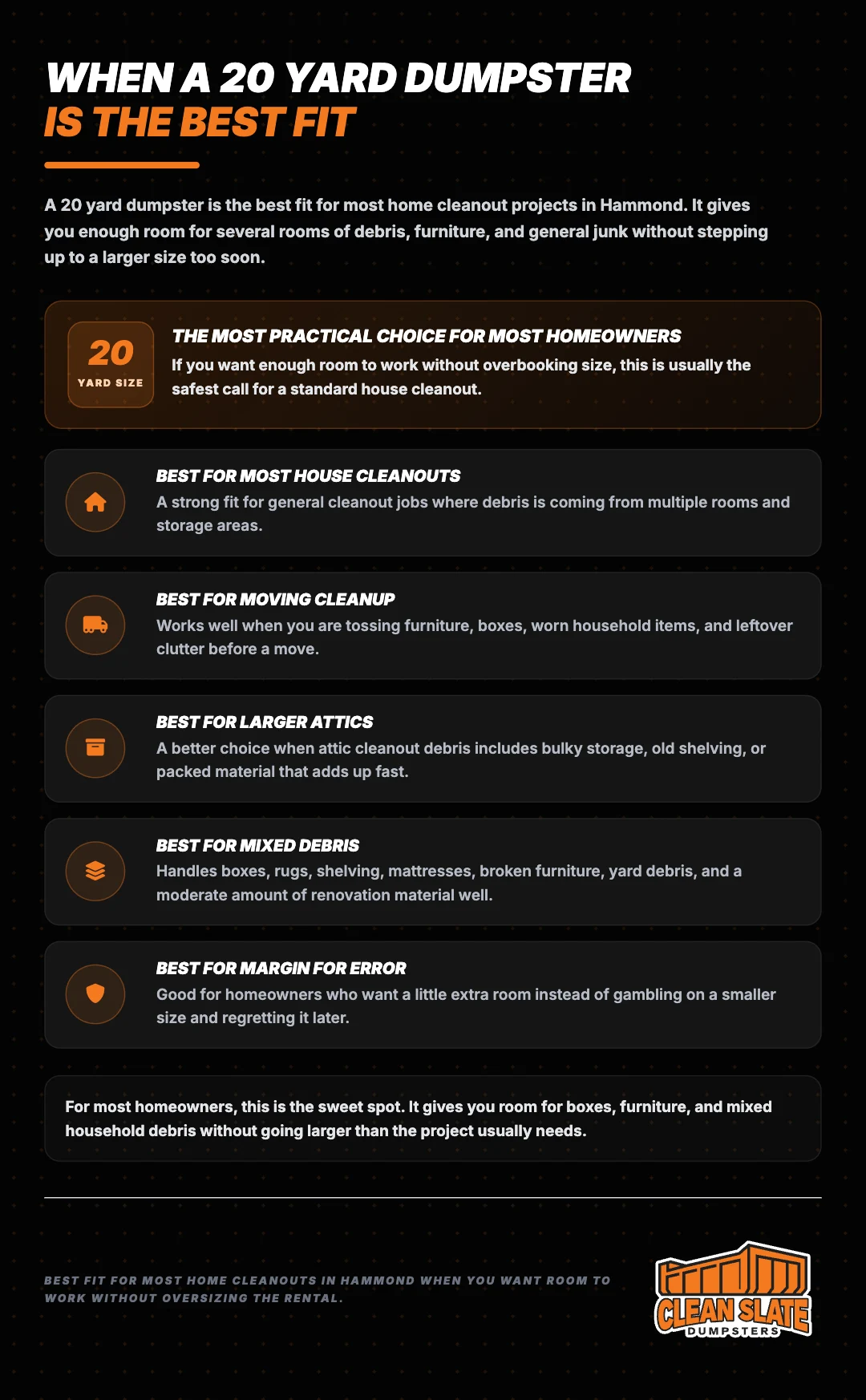
For most Hammond homeowner projects in this gap: kitchen remodels, garage cleanouts that grew, mixed-debris weekend cleanouts, the 20-yard wins. The math: $100 more, 33% more cubic yards, 2× the included tonnage, and a buffer against the second-haul tax that catches people who guess small.
The volume side: a 15-yard holds about 4 to 6 pickup truck loads and a 20-yard about 6, by Clean Slate’s size estimates. That’s 33% more cubic yards for a $100 price step. But volume is the easy part of the comparison.
The tonnage side is where the 20-yard quietly dominates. The 15-yard includes 1 ton of weight at the base price; the 20-yard includes 2 tons. Mixed kitchen-remodel debris, drywall, cabinets, countertop fragments, packaging, typically lands at 3,000 to 4,500 pounds for a single-room job. That sits at or near the 20-yard’s 2-ton allowance and runs past the 15-yard’s 1-ton cap by 1,000 to 2,500 pounds. At Clean Slate’s $65/ton overage rate, that’s an extra $32.50 to $81.25 on a 15-yard rental, against $16.25 at most on a 20-yard.
The second-haul math is the closer. A second 15-yard delivery costs another $299 base. There’s no repeat-haul discount, plus a one- or two-day scheduling delay while the second drop gets booked. Upgrading to a 20-yard at booking costs $100, full stop.
When the 15-yard roll-off still wins: tight driveway access in older Ponchatoula or central-Hammond neighborhoods, purely weight-bound jobs (concrete, single-layer roofing tear-off where the 1-ton cap is the constraint regardless of bin size), and genuinely small one-room jobs where 15 cubic yards is more than enough. When the 20-yard dumpster rental in Hammond wins, which is most of the time, the per-ton math is doing the work.
For most homeowner projects, the 20-yard still wins against the 30-yard, even though the 30-yard is cheaper per cubic yard. The 30-yard’s territory is specifically whole-house cleanouts, full remodels with multiple rooms, and active contractor work spanning 3+ days.
The volume jump from 20 to 30 is 50% more capacity. The tonnage jump is 2× (2 tons vs. 4 tons included). The price delta is $100, the same as the 15-to-20 step, for twice the added yards and twice the added tons.
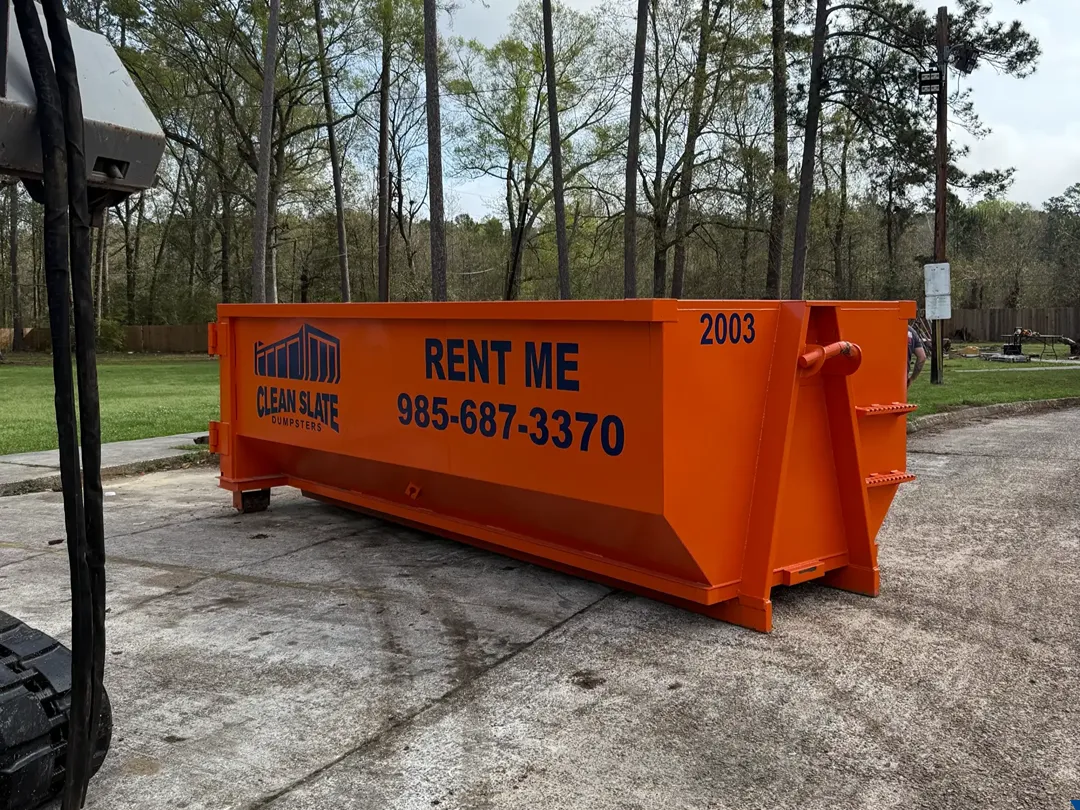
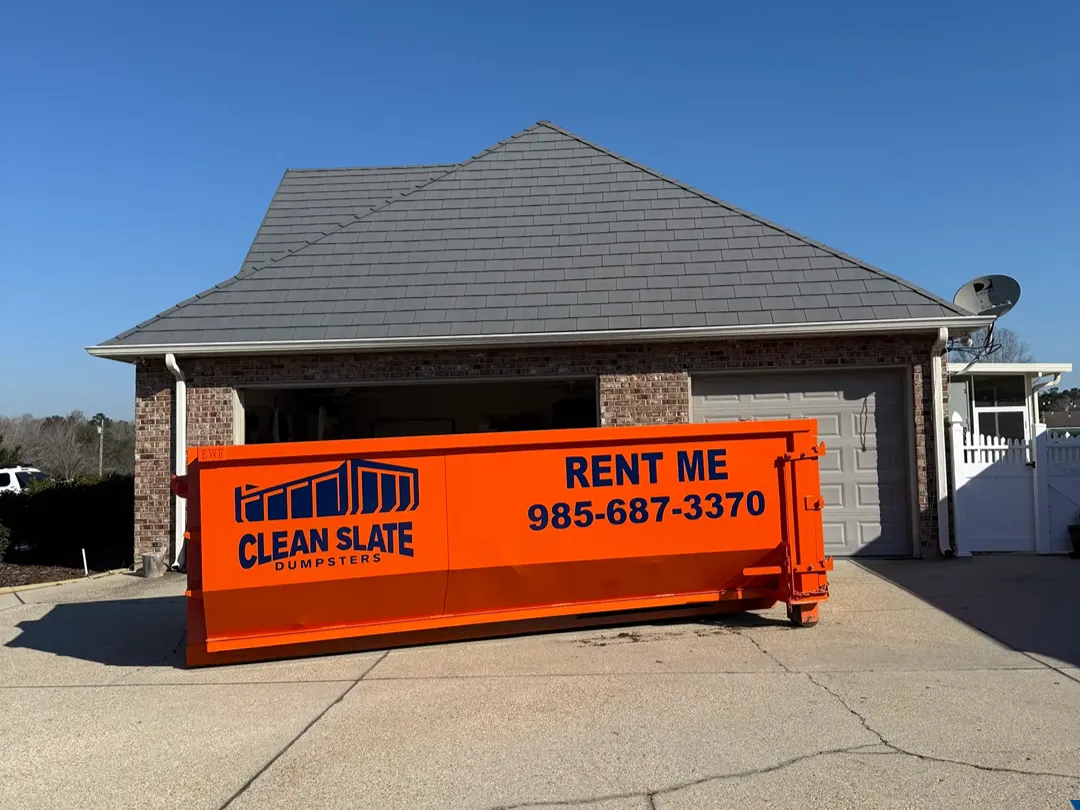
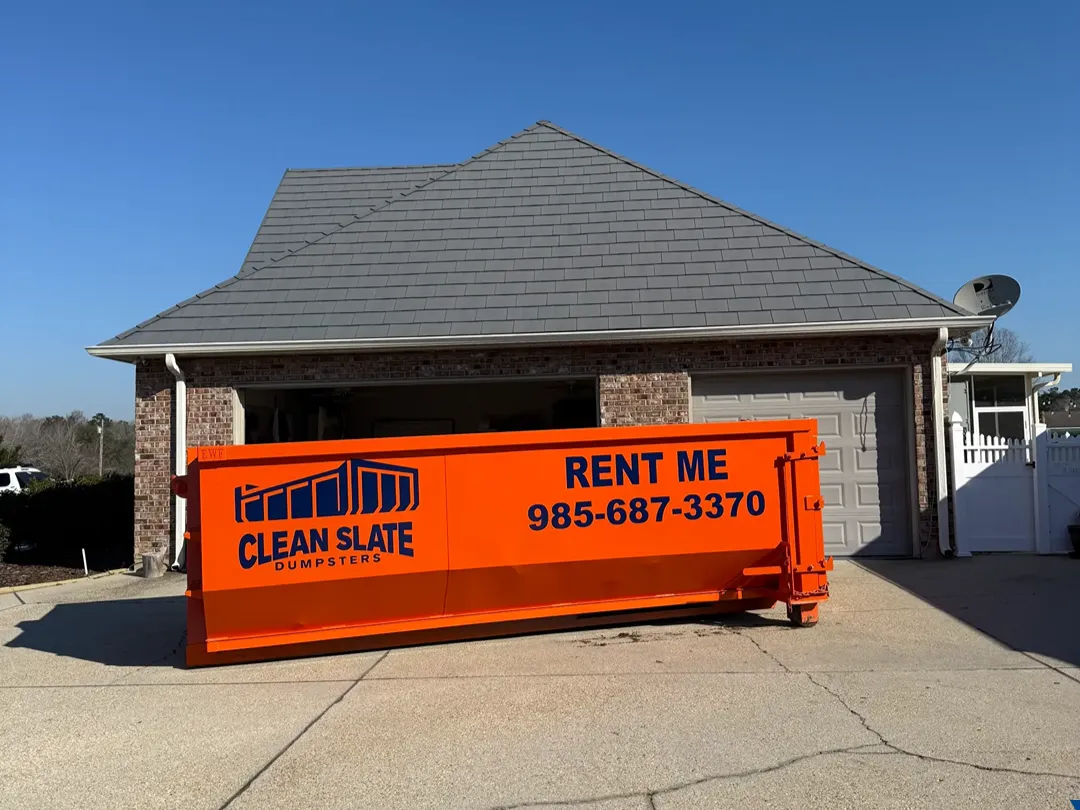
The access side is simpler than people expect. The 30-yard sits on the same footprint as the 20-yard, roughly 22 feet long and 8 feet wide, and the delivery truck needs a clear path about 22 feet long and 10 feet wide, plus overhead clearance free of low branches and power lines. So a driveway that takes a 20-yard usually takes a 30-yard too. Where older single-car driveways in central Hammond or older Ponchatoula neighborhoods get tight, the 15-yard’s compact footprint is the easier fit.
The “will I fill it” question decides the rest. A kitchen-only remodel rarely fills a 30-yard. A whole-house cleanout often does. A mid-size contractor jobsite with mixed debris, framing scrap, drywall, packaging, fixtures, usually fills the 30-yard over a 3-to-5-day cycle without needing a swap.
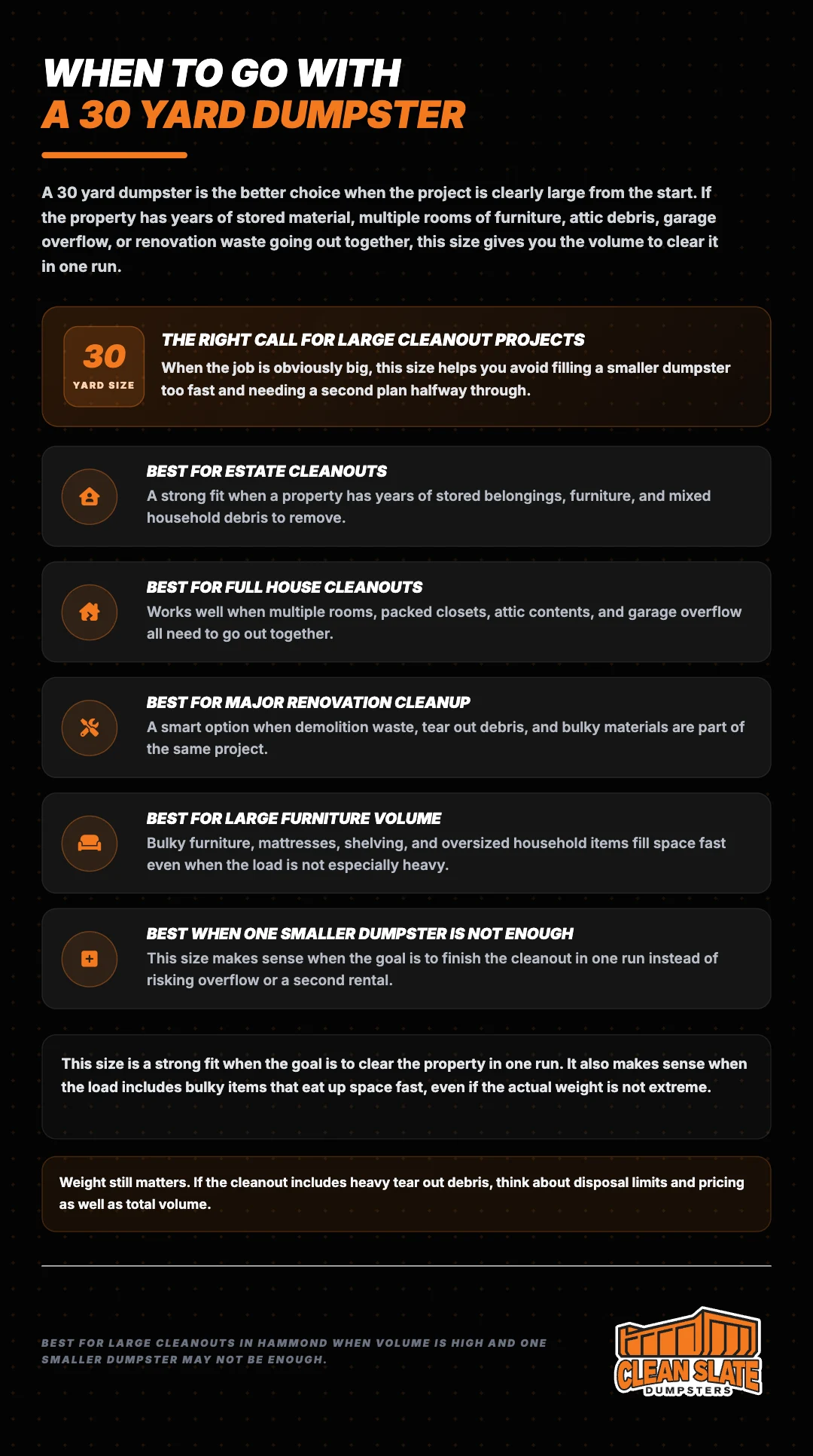
The decision usually falls along three lines: whole-house cleanouts and full multi-room remodels go to the 30-yard dumpster; kitchen-only remodels and mixed cleanouts in tight driveways stay on the 20-yard. For homeowner cleanouts that fall in between, the home cleanout dumpster rental in Hammond service page covers the scenarios in more detail.
At Clean Slate’s pricing, the per-cubic-yard cost is flat between the 15 and the 20, then drops at the 30:
The per-cubic-yard math is straightforward on paper. The catch is that it’s only the cost-per-yard if you actually use the yards. A half-empty 30-yard is functionally a $499 trip for what a $399 20-yard would have handled. The per-yard advantage only matters when the larger bin gets used to roughly 80% capacity or more.
The rule of thumb: if your best-guess project volume is within 25% of the smaller bin’s capacity, the smaller bin is the safer book, you’re paying for capacity you’ll actually use rather than capacity you might use. If your best-guess is over the smaller bin’s capacity by any meaningful margin, the larger bin’s per-yard math takes over and the upgrade pays for itself.
For the full per-day and overage math, the 15-, 20-, and 30-yard pricing breakdown walks through each size’s included tons, additional ton cost, and extra-day rate side by side.
Volume gets all the attention. Tonnage is what kills budgets. The per-ton-included math at Clean Slate breaks down like this:
The 20-yard’s per-ton math is roughly two-thirds of the 15-yard’s. That single number is the quiet reason the 20-yard is the most-rented residential roll-off size in the United States: homeowners stop renting the 15-yard once they’ve gone over on tonnage once.
The 30-yard’s $124.75 per ton is the lowest in the lineup, but the per-ton win only matters when the debris is heavy. A whole-house cleanout averaging 265 lb per cubic yard sits right at the 30-yard’s 4-ton ceiling, and loose household junk runs closer to 225 lb per cubic yard, so a full box usually stays inside the allowance. Anything heavier, concrete, full-thickness asphalt tear-off, dense construction debris, usually goes to a contractor dumpster rental in Hammond instead, where the per-dump pricing structure handles weight without overage math.
The takeaway: when a project’s debris is mixed and the volume is in the 15-to-20 gap, the 20-yard’s per-ton math wins on its own, the per-yard math is just a bonus.
The math is one thing. Real driveways are another. Here are four close-call scenarios pulled from Clean Slate’s Hammond and Ponchatoula deliveries, each ending at a different size for a different reason.
Garage cleanout in a Hammond subdivision. Two-car garage, decade-plus of mixed household goods, plus some patio furniture the homeowner couldn’t decide whether to keep. Between a 15-yard roll-off and a 20-yard. The decider was the patio furniture: the project could fit a 15-yard if the furniture stayed but would blow past it if the furniture went. The homeowner picked the 20-yard at booking. Filled to about 70% by the end of the weekend. Saved the second-haul tax.
Kitchen-only remodel in central Hammond. Single-room tear-out, cabinets, countertops, drywall, flooring, fixtures. Between 15 and 20. The decider was weight, not volume. Kitchen demo generates more drywall than people expect, and drywall comes in heavy. A 15-yard’s 1-ton allowance gets eaten by the drywall alone on a typical galley kitchen; the 20-yard’s 2-ton allowance held it. The post hit the 20-yard dumpster without going into overage.
Single-layer asphalt roof tear-off in Ponchatoula. 28-square architectural shingle roof. Between 15 and 20. The decider was weight again, the other direction this time. Roofing math runs about 0.5 cubic yards of debris per square and 250 to 400 pounds per square for architectural shingles, per industry roofing sizing guides and the NRCA-cited InterNACHI shingle weight reference. Even a single-layer tear-off blows past 1 ton on a 28-square roof, and the volume rarely justifies the 20-yard upgrade. The best answer wasn’t either bin, it was the flat-rate-by-squares pricing on the roofing dumpster rental in Hammond page.
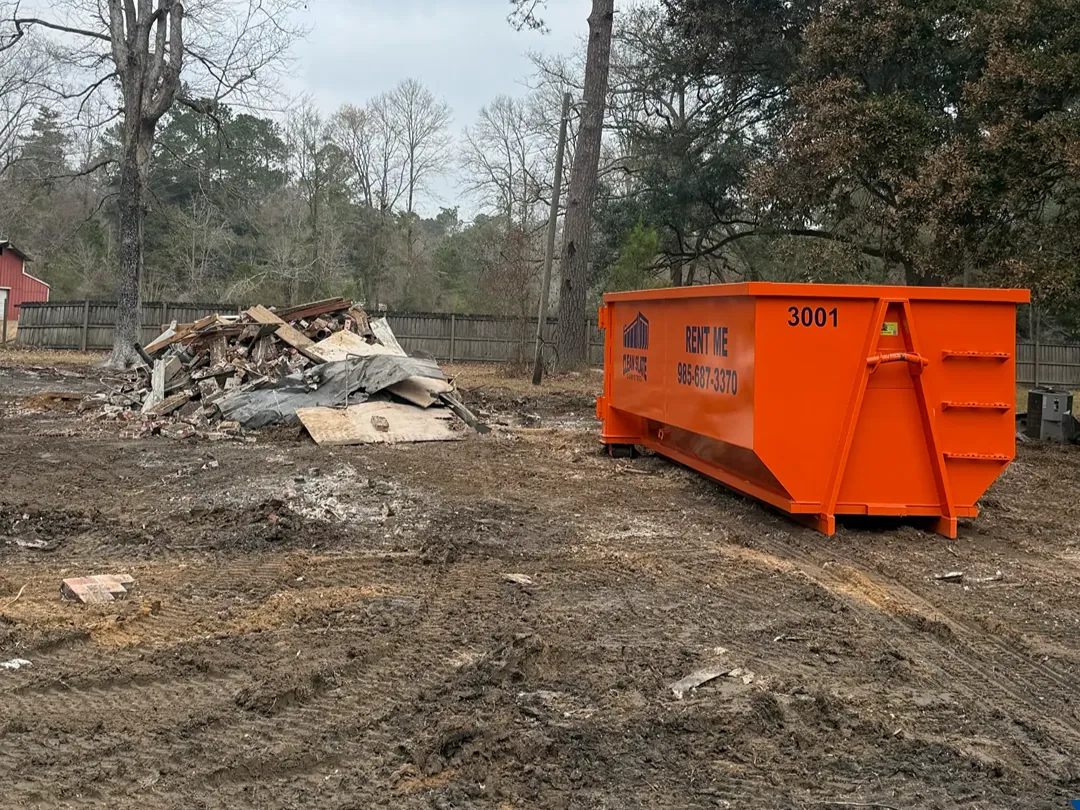
Whole-house cleanout, Tangipahoa Parish foreclosure. 1,800-square-foot single-family home, full clean-out of furniture, fixtures, and accumulated debris from a long-vacant property, 4-day job. Between the 20-yard and 30-yard. The decider was capacity and tonnage together: the 20-yard would have needed a mid-job swap (and a second base fee); the 30-yard dumpster‘s 4-ton allowance combined with Clean Slate’s Dump-and-Return option covered the full clean-out across two cycles without restarting the booking.
The pattern in all four: when two sizes both look workable, the deciding factor is almost always the weight side of the math, not the volume side.
When the math between two sizes feels 50/50, and it usually feels 50/50 because debris volume is genuinely hard to estimate from the front of the project, go up one size. The asymmetric risk math leans hard that way.
The cost of going one size too big is $100 either way (15→20 or 20→30). That’s the entire downside. The cost of going one size too small is a second base fee ($299, $399, or $499 for the same-size repeat) plus a one-or-two-day scheduling delay plus, often, a tonnage overage of one to three tons at $65 per ton. Even on the cheap end, “too small” costs three to seven times what “too big” costs.
The two exceptions where the rule flips:
For everything else, when the call is close, the five-minute phone alternative usually settles it faster than re-running the math. Call 985-687-3370 and walk through the project. Sizing recommendations are no-charge and delivery is usually same day, guaranteed next day.
These are the size questions Hammond and Ponchatoula homeowners ask most before booking. If you’re still between two sizes after the cost math above, the answers below cover the most common edge cases.
Almost never. A typical Hammond kitchen-only remodel generates 3,000 to 4,500 pounds of mixed debris, which fits inside the 20-yard’s 2-ton allowance with headroom. The 15-yard’s 1-ton cap is the usual fail point. The 20-yard’s extra cubic feet also absorb unexpected additions like floor underlayment or cabinetry that grew in scope mid-project.
$100 base price difference at Clean Slate Dumpsters: 15-yard $299 (1 ton included) vs. 20-yard $399 (2 tons included). Both have the same $65/ton overage fee and $15 extra-day rate. The 20-yard’s per-ton-included math is roughly two-thirds of the 15-yard’s, which is why most homeowners pick it for mixed-debris projects.
Usually no. Two 15-yard rentals at $638 base for the same 30 cubic yards costs more than one 30-yard rental at $499 for 30 cubic yards. The per-haul base price doesn’t discount for repeat customers on the same job. Single larger rentals or the Dump-and-Return option win on cost for any project over about 12 cubic yards.
The 30-yard: $16.63 per cubic yard ($499 base ÷ 30 yards). The 20-yard runs $19.95/yd and the 15-yard $19.93/yd, close to the same. The per-yard advantage only matters if you actually fill the larger bin. A half-empty 30-yard is effectively a $499 trip for what a $399 20-yard would have handled.
The 30-yard for multi-day jobs and active jobsites, where the 4-ton allowance and longer rental cycle hold mixed debris without swaps. The 20-yard for shorter tear-outs and roofing work when not on the roofing flat-rate pricing. The contractor dumpster rental in Hammond service page covers repeat-job pricing and account setup for crews running multiple bookings.
For more questions on placement, weight, and permits, see all dumpster rental FAQs.
Still between two sizes? Skip the guessing.
The Clean Slate team books dumpsters in Hammond, Ponchatoula, and across Tangipahoa Parish every day, five minutes on the phone usually settles a close call.
Call 985-687-3370 for a free sizing recommendation. Usually same day. Guaranteed next day.
Picking between two adjacent sizes comes down to three pieces of math: cost-per-cubic-yard (the larger bin wins if you fill it), cost-per-ton-included (the 20-yard quietly halves the 15-yard’s per-ton number), and the asymmetric risk of going too small versus too big. For most Hammond homeowner projects, the 20-yard is the answer. For whole-house and multi-day contractor work, the 30-yard. The 15-yard wins on tight driveway access and small, weight-bound jobs. When in doubt, go up one.